
Having completed one miniature tapestry, I was eager to try more weaving on my little box loom, and to start considering more advanced loom designs, but this is where I got completely sidetracked. This video by Kristine Vike introduced me to an ancient craft I had never heard of before - tablet weaving.
To summarize, tablet weaving is a style of weaving known to have been practiced since the Bronze Age, used primarily for creating narrow decorative bands. Long warp threads are passed through holes in the corners of square tablets (or cards) oriented vertically, creating a shed between the threads going to the upper holes and those going to the lower holes. The weft thread is passed through the shed, then locked in place by rotating the tablets such that which threads go up and which go down changes. By using different colored threads in different holes and turning the tablets either forward or backward, complex patterns can be created.
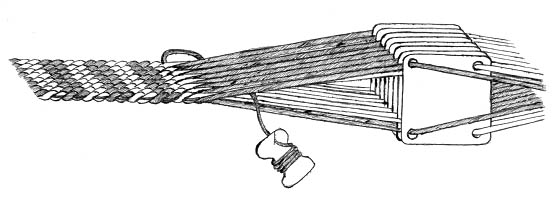
I found this concept intriguing. The idea of creating a pattern by turning a series of cards either forward or backward according to some sequence really appealed to my programmer brain. And since it doesn't really require any specialized tools (with the backstrap method you don't even need a loom), it seemed like something I could quickly try out before moving on to other projects (Ha. ha.). So I took a deck of bridge-sized playing cards, cut them square, punched holes in the corners, cut a shuttle out of cardboard, and started cutting lengths of the Sashiko thread. To start with, I followed the Youtube tutorials of Elewys of Finchingefeld in her series "Weave Along with Elewys".
The first pattern in this series was the Oseberg weave. This is a pattern that was found in a burial mound in Norway dated to 834 AD. Unlike Elewys (who uses an inkle loom), I used the backstrap method - I tied one end of the threads to a table leg and the working end to my belt. This was a very simple pattern, with cards all turning forward for a while, then all backward for a while, etc. I did not have a good feeling for how tightly to pull in the weft thread (or how to manage thread tension in general), so this came out extremely lumpy and misshapen. But hey, it's a ribbon, it doesn't fall apart, and it sorta has a pattern on it, so I'm calling it a successful first experiment.

No comments:
Post a Comment