Monday, October 28, 2024

Basketweave Belt

Basketweave Belt
December 2022
Materials: Maysville Carpet Warp (8/4 Cotton)
Tools: 26 weaving cards
Length: ~ 112 cm (44 in)
Width: 3 cm (1.2 in)
Pattern courtesy of Catherine Weaver, Tablet Weaving in Theory and Practice 
 
This was my first tablet weaving project that ended up having a practical application. I got the pattern from Catherine Weaver's blog Tablet Weaving in Theory and Practice. At 26 cards, this was quite a bit wider than anything I had tried before. This made it awkward to try to tie onto the belt around my waist, so I came up with a new approach, where I instead looped the already-woven portion around my belt, attached the end to some solid object ahead of me, and pushed on it with a foot to maintain tension. This seemed to work fairly well, so it ended up being an approach I kept using for most of my future projects.

Once I was done weaving, I cut several inches off the start of the band, as it had taken some time for the tension to equalize and the pattern to start looking right. I then folded that end of the band over itself around 2 metal D-rings and sewed it down, creating a simple belt which I have since worn quite a bit. As you can see below, one consequence of this 2-ring style of belt fastener is that the end of the belt ends up being reversed when worn. Luckily, the reverse side of this pattern still looks pretty interesting, so this isn't necessarily a problem. And I was really stoked to be able to wear something I wove by hand (to be honest, I still am).
 

Friday, October 18, 2024

St Bertille's Sleeve - Skip hole weaving

St Bertille's Sleeve Trim
November 2022
Materials: Maysville Carpet Warp (8/4 Cotton)
Tools: 16 weaving cards
Length: ~ 132 cm (52 in)
Width: 13 mm (0.51 in)
 
I think this is the first tablet woven piece I'm actually proud of. It's a skip-hole pattern, meaning that the pattern (aka non-border) cards only have 2 threads each, so half of the holes are empty. This produces a sort of 3-dimensional effect that can look quite neat. The weaving process remains the same, although you have to use something like a pencil (I used little wooden gardening stakes) to hold the cards in place when not turning them, as they will otherwise rotate into a diagonal position.

The pattern originates from the tablet woven trim on a Catholic relic - a piece of sleeve presumed to have belonged to St Bertille of Chelles Abbey in the 7th century. It was originally woven in silk, and is only 9 mm wide, with most of that taken up by the border.

I made a couple of changes to my overall process when weaving this one. For one, I cut a new shuttle out of an old credit card. The rigidity of it made it much better than cardboard for beating the weft thread down, which makes for a tighter weave along the forward-backward direction. This was also quite a bit longer than my previous pieces, and I came up with a somewhat clever way of quickly measuring out threads: I flip over my spinning desk chair and prop it up, then tie the end of the string to one "spoke" of the base. I then spin the base of the chair while holding the thread so that it wraps around it. After the base has rotated as many times as I need threads, I cut through all of the wrapped up thread to produce the threads I need, all the same length.

Thursday, October 17, 2024

Hallstatt 152 - A new yarn


Hallstatt 152
November 2022
Materials: Maysville Carpet Warp (8/4 Cotton)
Tools: 12 weaving cards
Length: ~ 66 cm (26 in)
Width: 15 mm (0.59 in)
 
Having completed a couple of sample tablet weavings and still wanting to do more, I figured it was finally time to acquire some more appropriate yarn. The Sashiko thread had worked fine, but it came in fairly small skeins, so it was inconvenient and costly to use for any weavings of significant length. I ended up ordering some tubes of 8/4 Maysville Carpet Warp.

Skipping ahead in the "Weave along with Elewys" video series, I wove a version of the "Hallstatt 152" design. This one is based on a scrap of fabric dating from 800-400 BCE, found in an old salt mine in Hallstatt, Austria. The pieces found in that excavation are some of the oldest examples of tablet weaving to be uncovered by archaeologists. The particular design I followed here was an initial recreation of the piece found in Hallstatt, which was later determined to be inaccurate (archaeologists now believe it was woven using a more complex "skip-hole" tablet weaving technique).

Weaving with the new yarn was a little tricky initially, as it took me some time to get used to the heavier weight and increased friction of it. As a result, this piece came out lumpier than I'd like. But it also seemed sturdier and more durable than my previous weavings, suggesting that this carpet warp would be good for creating practical pieces such as belts and straps.

References

3. K. Grömer. "Tablet-woven Ribbons from the prehistoric Salt-mines at Hallstatt,
Austria – results of some experiments" 2005: https://www.academia.edu/11916994/Tablet_woven_Ribbons_from_the_prehistoric_Salt_mines_at_Hallstatt_Austria_results_of_some_experiments

Wednesday, October 16, 2024

Second go at tablet weaving - Ladoga pattern

Ladoga Pattern
November 2022
Materials: Sashiko thread
Tools: 12 weaving cards
Length: ~ 63 cm (25 in)
Width: 11 mm (0.43 in)

Continuing to weave along with Elewys, I tried another simple pattern - this one from a Norse settlement near Lake Ladoga dated to the 10th-12th century. As you can see, I complicated my backstrap setup somewhat to allow for more length - now incorporating some C clamps and a dumbbell. I was starting to get a better feel for thread tension on this piece, so it came out much nicer and more regular-looking than my first attempt. The pattern itself was once again dead simple - border cards turn forever forwards, middle cards switch direction every 12 turns.

References:

2. Ladoga Pattern weaving tutorial: https://www.youtube.com/watch?v=RCgcFc-EdzU

First try at tablet weaving - Oseberg weave

Oseberg Weave
November 2022
Materials: Sashiko thread
Tools: 10 weaving cards
Length: ~ 47 cm (18.5 in)
Width: 9mm (0.35 in)

Having completed one miniature tapestry, I was eager to try more weaving on my little box loom, and to start considering more advanced loom designs, but this is where I got completely sidetracked. This video by Kristine Vike introduced me to an ancient craft I had never heard of before - tablet weaving.

To summarize, tablet weaving is a style of weaving known to have been practiced since the Bronze Age, used primarily for creating narrow decorative bands. Long warp threads are passed through holes in the corners of square tablets (or cards) oriented vertically, creating a shed between the threads going to the upper holes and those going to the lower holes. The weft thread is passed through the shed, then locked in place by rotating the tablets such that which threads go up and which go down changes. By using different colored threads in different holes and turning the tablets either forward or backward, complex patterns can be created.
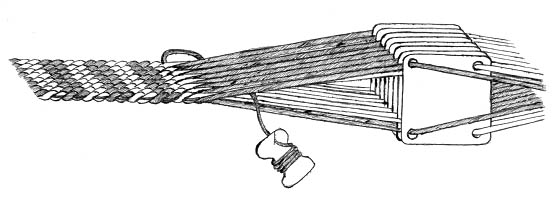
Figure 4: Using 8 Tablets to Weave a Band

I found this concept intriguing. The idea of creating a pattern by turning a series of cards either forward or backward according to some sequence really appealed to my programmer brain. And since it doesn't really require any specialized tools (with the backstrap method you don't even need a loom), it seemed like something I could quickly try out before moving on to other projects (Ha. ha.). So I took a deck of bridge-sized playing cards, cut them square, punched holes in the corners, cut a shuttle out of cardboard, and started cutting lengths of the Sashiko thread. To start with, I followed the Youtube tutorials of Elewys of Finchingefeld in her series "Weave Along with Elewys". 

The first pattern in this series was the Oseberg weave. This is a pattern that was found in a burial mound in Norway dated to 834 AD. Unlike Elewys (who uses an inkle loom), I used the backstrap method - I tied one end of the threads to a table leg and the working end to my belt. This was a very simple pattern, with cards all turning forward for a while, then all backward for a while, etc. I did not have a good feeling for how tightly to pull in the weft thread (or how to manage thread tension in general), so this came out extremely lumpy and misshapen. But hey, it's a ribbon, it doesn't fall apart, and it sorta has a pattern on it, so I'm calling it a successful first experiment.

References

1. Tablet weaving primer by Shelagh Lewins: https://www.shelaghlewins.com/tablet_weaving/TW01/TW01.htm
2. Kristine Vike's video on tablet weaving: https://www.youtube.com/watch?v=XmbWwGK1wK0
4. Oseberg weave tutorial by Elewys of Finchingefeld: https://www.youtube.com/watch?v=xM_PwRQSfvo